alt=


 alt=

Coach For College


The College Celebration!


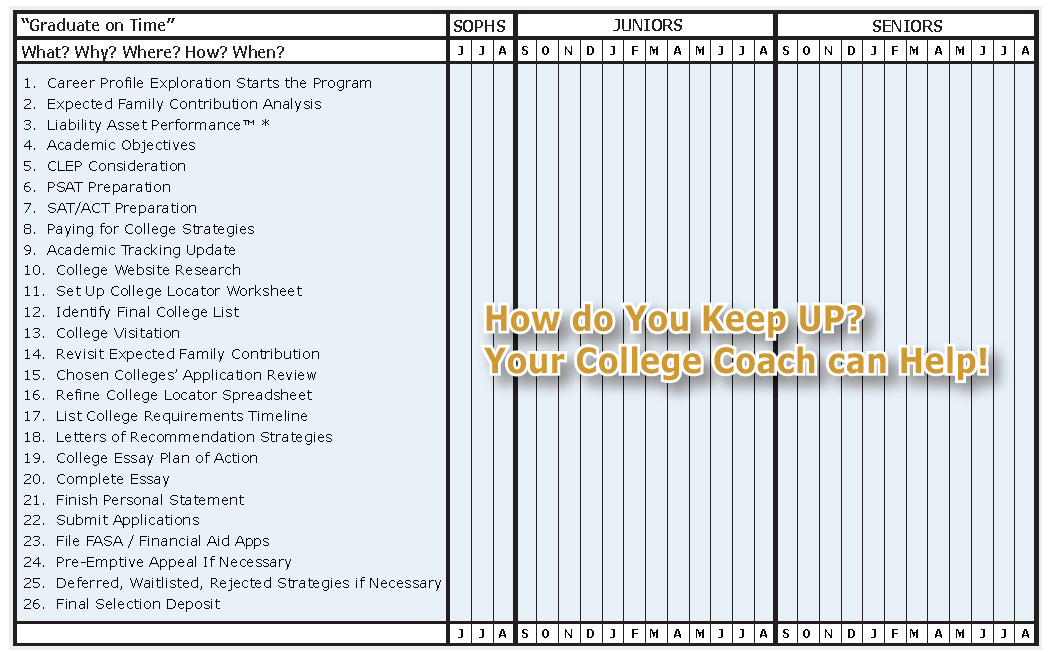
Actionable Steps Timing Your Sequence


Are you preparing to go to College?

Are you overwhelmed with all the information?

Are you tired of searching websites for answers?

Are you sure you have the right questions?


Going to college is an educational experience even before the actual College Education process starts. 

"Best Practice" answers to the right questions for your family's individual situation can result in a "Celebration" rather than a stressful situation wondering if you could have done better. 


Coach For College Is Your Solution 


"The Only Failure Is The Failure To Engage"


Who Can Coach For College Help?

Not everyone. Are you a "Skimmer" or a  "Diver"?

Skimmers insist on doing their own research. They are slow to commit because they believe inaction somehow will benefit them in the long run. 

Divers are ready to take action. Their concerns are to understand, evaluate, and determine whether a solution to their problem can be integrated into their daily processes. 

Coach For College is primarily directed towards "Divers", those people who want to help themselves by taking relative actions that meet their goals and expectations. 


What Is The Purpose Of This Coaching Program?


At this point, let's be honest! 


  • Create Curiosity
  • Create Excitement
  • Inspire you to seek more information


Fair enough. "Honesty is not the best policy, it's the ONLY policy" that we believe allows us to work together so we both enjoy a pleasant outcome. And yes, a "Celebration" when we reach our mutually agreed upon goals and expectations. 

So, let's get started. 

Important: Many seniors have already applied. You merely enter the program at the place where you want help and you can leave at any time. 

Coach For College is a monthly membership, no up front fees, and you can cancel at any time. 


College Costs Continue To Rise


Based  upon a survey of 3,500 Colleges across the United States, the College Board publishes each year its "Trends in College Pricing". 

Trend Pricing includes a "total average cost" figure for each school. The cost figures include tuition and fees, room and board, books and supplies, transportation, and a small miscellaneous expense. 

The figure is often referred to as the "Cost Of Attendance ("COA"). 

Unfortunately, the COA included on many college websites and online calculators often times do not convey the "True Cost of Attendance (TCOA)" for a respective school. 

In fact, when schools send out financial awards understanding "if" there is a difference between the listed "COA" and "TCOA" can be the difference in receiving additional financial aid. 


  • [Strategy Point] The good news, there is a "bullet proof" way to find the True Cost of Attendance for "any" school. 


Choosing The "Right College for Me"


Four year graduation rates are dismal at best. According to ACT. org, only 49% of private school freshman and 29% of public school freshman can expect to graduate in four years. 

Percentages for dropping out, transferring schools, and changing majors compound the problem, representing subsets of the BIGGER problem...failure of career planning with an "informed" school selection process. 

School websites can be problematic in finding accurate data that you need in your decision making process. 

Students oftentimes fail to assess their interests, strengths, and attributes toward identifying possible occupations that might be of interest to them prior to going to college.

As a result, they have no major in mind or they change majors once they are attending college.

There is never a "perfect plan", but a starting plan would minimize many of these mistakes. 


  • [Coaching Benefit] Coach For College provides "two" different software programs as part of your membership that help find the right college for you, based upon numerous criteria that you can identify. The best part is the way the software searches schools returning a short list of schools that meet your selection demographics and interests...A VERY BIG TIME SAVER!


Test Prep - Which Test Should I Take? 


First, 75% of High School students practice before they sit for the ACT or SAT. For the most part, students understand the value and pay off of practicing. 

The big disconnect is not intent, practice; but the "overtaxing" of the student's time availability by taking both the SAT and ACT.

Every college accepts both, so why not focus on one?

ACT "Super -Scoring" and SAT "Choice"  are recent developments that demonstrate college is big business.

As such, they do and will compete for students who meet their desirable criteria. 

By examining your target schools, we can easily determine whether or not it is to your advantage to take one test over the other, or both.

In most cases, unless you are applying to certain schools, either test will not put you at a disadvantage during the admissions process. 


  • [Coaching Strategy] In "many" cases, not all, focusing on one-test preparation and taking the SAT or ACT several times will result in a higher total score that the College counts. Exceptions can easily be  identified with our software examining the respective college freshman class data. Example, some schools might have a high percentage of incoming freshman taking the SAT.  


Student Positioning


Colleges operate big businesses, they are in the marketing and sales business as well as the education business. 

They convey a public image for a reason, they want to attract students who meet their acceptable profile and then become competitive towards the offers they make  to "positioned students" who meet their profile. 

Students who understand this, and provide the colleges with not only what they are looking for, but also in a unique way that demonstrates "sincere interest" will usually receive acceptance with the best offers. 

Student Positioning is really establishing the student as the owner of their own small business, "Student PR Agency". 

A professional looking Student Portfolio should accompany you applications when possible. 


  • [Coaching Strategy] Set up a web page (blog if motivated)  with your own URL address. Write about your high school experiences or something of interest to you. Place a video on the page where you talk about what your goals are going to college, your interests, etc. There are ways to customize this approach for a particular college, and you can make it either public or private (just for the college/s).
  • Coach for College provides this as part of your membership. 


Application Process - "Putting Your Best Foot Forward"


Everyone can submit an application but are you maximizing your impression on admissions and financial officers?

Apply Wise provides counseling sessions covering each admissions topic and gives students guided practice through interactive games and activities. 

From selecting reach, target, safety schools to answers to key strategy questions, students and parents who use this methodology experience a 90%+ rate of being admitted to their top 3 college choices. 

Don't be "average" when you are submitting your applications. You want and deserve an impressive "marketing package" that you submit to colleges. 


  • [Coaching Alert] Learn how to write a winning personal statement, create a "BRAG" Sheet, how to create a great Common Application, "Insider Tips" from a Former Dean of Admissions, "Top Five Application Mistakes, and much more.


"EFC" - Your Expected Family Contribution


Most of you know about EFC, but do you have a complete understanding how the formula works?

Many online calculators are not accurate especially if you want to minimize your EFC!

For example, did you know your contributions to a retirement plan in the current "base year" are added back into your results increasing your EFC?

Such contributions are considered "untaxed income and benefits". and there are more. 

And then there are the financial aid methodologies schools use, Federal Methodology ("FM") and Institutional Methodology ("IM - Profile").

There is a big difference and understanding how they apply to your individual situations and the schools you are applying to can make a big difference in what you are expected to pay. 

Even for current seniors, families have time to lower their EFC and maximize financial help from colleges. 


  • [Coaching Strategy]  EFC calculators can be misleading especially when you only receive one result. You must identify your application schools' methodology, Federal or Institutional. In most cases you should have your EFC calculated both ways so there are no surprises. 
  • There are ways to lower your EFC.


"FAFSA" -  Free Application For Financial Aid


Everyone should file the FAFSA even if you "think" you will not qualify for financial aid. Otherwise, students who position themselves properly can miss out on "merit aid". 

FAFSA computes the "IM EFC" and for some schools, as second Profile Form are required. And taking it further, some colleges will require their own Institutional Application Forms that require additional information. Some states also require forms to determine the student's eligibility for state financial aid programs. 

The completions of these forms are often times riddled with mistakes. 

There are strategies, for example you can create "competition" among schools because you list six colleges on the FAFSA form. The form results are submitted to all six colleges  which see the colleges you are applying to, regardless of whether or not you truly intend to go to each college.


  • [Strategy Alert] Know what application forms are required by each college (FAFSA, Profile, Etc.), track the deadlines for each college you are applying to, and electronically file the forms if possible. Always file the FAFSA so you are not eliminated from possible forms of financial aid (ex. merit aid, appeals process, etc.). File as early as you can, especially for private schools. 


Student Aid Report - "SAR"


When you file the FAFSA electronically (which you should), in one to two weeks you will receive the Student Air Report. 

Your Expected Family Contribution (EFC) will be located in the upper right hand corner of the first page.

Do not assume the stated EFC is accurate.  

Errors and updated tax information (FAFSA many times is completed before you file your actual tax return) must be corrected and the form re-filed immediately. 

There are three reasons why they student must update the information on the original FAFSA form. It is important to understand when these occur. 

Many people miss  this step. In order to increase the chance of receiving grants ("free money"), a copy of the SAR should be sent to the appropriate colleges with a request for a financial aid offer. 

Here again, do no assume the college has a copy of your SAR. Plus, requesting the financial aid offer can demonstrate your genuine interest in attending the school. 


  • [Strategy Clarification] You need to understand the difference between "CSS" and "SAR". CSS is the "College Scholarship Service Data Confirmation Report similar to the SAR without the EFC. The CSS allows students and parents to correct data for the Institutional  Methodology calculations. 


Financial Aid


Financial Aid money is given by the Federal and State governments in additions to the individual colleges themselves. 

There are basically two types of financial aid. 

  1. Self-Help: Interest subsidized loans and work study;

  2. Gift-Aid: Grants and scholarships, this money does not have to be paid back. 

There are two factors that determine the amount and type of financial aid;

  1. The merit of the student (scholastic, athletic, musical, - STUDENT POSITIONING);

  2. The financial need of the student, or "Needs-Based".

There are many "qualifying factors" that determine the amount and type of Financial Aid a student can receive. 

The complexities and strategies available can be overwhelming without the correct planning tools (for example, "accurate software") and understanding the specific demographics and admission / financial aid policies of the respective colleges.


  • [Coaching Strategy]  Do not send family financial information to a college unless until after you receive your SAR report, and then only to correct information and/or to comply if you are selected for verification (Document FAFSA Data). 


  • Verification Change 2012-2013 - New, historically, colleges only had to verify 30% of the applicants chosen by CSS for verification. Now this has to changed to "ALL" applicants chosen by CSS! In addition, colleges can choose unilaterally to verify on their own and the best policy is just to expect it. 


Appeals Process -  "Professional Judgment"

The College Financial Aid Officer has greater power than an IRS Agent when it comes their ability to exercise "subjective judgment", or the proper term "Professional Judgment". 

Professional Judgment is the authority to change data to reflect the student / family's ability to pay. 

"Special circumstances" are the reasons that allow the exercise of Professional Judgment. 

"Personal Touch" and  "adequate documentation" are critical components to a successful appeal.

Remember, this authority given to the Financial Aid Officer is guided by Sections of the Higher Education Act.

Thus it is important to understand these financial aid rules and regulations, but remember there is "latitude" and an individual evaluates your special circumstances.


  • [Strategy Update] New, all applicants selected for verification either by the school or CSS (Department of Education) must complete verification before any Professional Judgment adjustments can be made to the FAFSA. 


Final College Choice


Congratulations and you are about to "Celebrate". 

Throughout this process, it is important to have access to the proper tools and personal coaching  to assimilate accurate information for the best decisions that suit your individual situation. 


A few examples would be;


  • Software that provides you the ability to choose the right schools for me, demographic and freshman class profile data, costs, enrollment yields, financial aid, etc. -- all in one software program. 


  • Accurate "EFC Calculations" from a "valid EFC Calculator" with the proper information inputted.
  • Work In Process Checklists for Admissions, College Financial Aid Comparison, Student Aid Report, Verification Worksheet, Award Letters, Award Appeal Process, Strategies, and others.
  • Specialists (Approved "Affiliates") at discounted rates (or part of Coach for College)  in the areas of  Career Assessment,Test Prep,  Student Positioning, Admissions, and alternatives such as "CLEP" (College Level Examination Program), Debt Analysis, Cash Flow Analysis, etc. 
  • Personal Coaching where you can ask any question and receive a responsive timely answer.


Regardless of where you are in the College Bound experience, I sincerely hope you found the above information informative and educational. 


Are you a "Skimmer" or a "Diver"?

 alt=

I welcome your inquiry and my promise to you, if we decide to work together I will exceed your expectations.


If these objectives align with your goals...


  • Students Choose Dream College™

  • Parents Achieve Financial Clarity™

  • Families Experience College Success™


Please contact me and send a brief email on where you are in the College Bound Process. I will respond promptly, there is no obligation. 


"The Only Failure IS The Failure To Engage"!


Email: Coach For College
Free EFC Course
* indicates required